
Patients who have lost every tooth are often told there is little left to be done beyond a set of dentures. That is rarely true. What determines your real options when you are missing teeth is not how long you have gone without them, but what has happened to the bone underneath in the meantime.
What Causes Total Tooth Loss
The leading cause of total tooth loss in adults is gum disease, followed by widespread tooth decay. A cavity left untreated long enough destroys a tooth from the inside; periodontal disease destroys the bone holding that tooth in place. Trauma accounts for a smaller share, and tooth decay under an old restoration accounts for more than most patients expect. For many patients it happens gradually instead: one tooth fails, then a crown or a bridge is placed over it, then the remaining teeth take more load than they were meant to and follow the same path, tooth by tooth, until the last natural teeth are gone. Good oral hygiene, regular dental visits, and preventive care are what prevent tooth loss in the first place, but by the time every gap has joined up, the question has changed from prevention to reconstruction.
Why the Entire Jaw Shrinks
Every tooth root stimulates the bone around it, which keeps the ridge at its full height and width. Lose a single tooth and the bone at that one site begins to shrink. Once all the teeth are lost, that stimulation stops across the whole arch, and the body begins resorbing bone everywhere at once rather than in isolated pockets. Over years this can reduce a jaw that was once tall and broad to a thin ridge. Bone does not regenerate on its own once it has gone.
What the Progression Looks Like
| Stage | What’s happening in the bone |
|---|---|
| All teeth present | Full bone height and width, actively stimulated by tooth roots |
| Teeth lost | Resorption begins across the arch almost immediately |
| Early years | Ridge height and width decrease steadily, changing the jaw’s profile |
| Extended years without replacement | Bone loss can become severe enough to expose vital structures, including nerves, that were previously well protected |
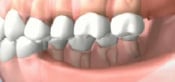
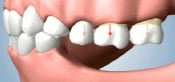
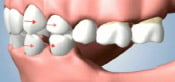
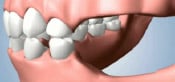
Take a look at the images above to see the progression of jaw bone shrinkage due to missing teeth. Here, we see the loss of bone height from a profile view. Note that as more bone is lost, vital structures – such as nerves – become exposed.
Advanced bone regeneration and bone preservation techniques can help preserve and restore the jaw bone, to make dental implant placement possible, even in cases of severe bone loss.
Eating, Nutrition, and Quality of Life
The consequence patients notice first is that food becomes difficult to chew. Without teeth, and often with a denture that moves while you eat, it is hard to break food properly before swallowing. Fruits and vegetables, nuts, and any cut of meat that needs real force tend to be the first things dropped from the diet, and what replaces them is usually softer and more processed. Patients rarely describe this as a health problem, but over years a narrowed diet affects nutrition and general health, not only dental health. This is one of the least discussed effects of tooth loss and one of the most consistent, and it is rarely raised at a routine dental appointment.
Speech, Bite, and the Shape of the Face
Teeth do more than chew. They shape sound, and patients without them often cannot pronounce certain words clearly, particularly sounds that need the tongue to meet the upper teeth. The bite changes too: with no natural teeth setting the vertical dimension, the lower jaw closes further than it was designed to, altering the occlusion and loading the jaw joint in a way it was not built for. That can cause pain and contribute to headache patterns patients rarely connect to their teeth.
The cosmetic effect follows the bone. As the ridge resorbs, the lower third of the face loses its support, the lips lose fullness, the cheeks look sunken, and the skin around the mouth begins to sag. It is why patients look older than they are, and I cover the mechanism in detail on my page about facial atrophy.
Do Dentures Prevent Any of This?
A conventional full denture does not cause bone loss on its own, but it does not prevent it either. It rests on the gum rather than replacing the roots, so nothing underneath is being stimulated. That is why a denture that fit well when it was made needs relining or remaking every few years as the ridge beneath it keeps changing shape. Partial dentures have the same limitation across a smaller area. The full effects of denture wear are worth reading if that is where you are now.
Why the Upper Arch Is a Special Case
When the upper teeth have been gone for a long time, resorption lets the maxillary sinus expand downward into the space bone used to occupy. That is a normal consequence of long-term tooth loss, but it does mean a sinus lift is often needed to reposition the sinus floor before anything can be placed above.
Treatment Options After Total Tooth Loss
Severe bone loss does not rule out a fixed result, and this is the biggest misconception I meet. Grafting can regenerate enough volume to work with, and where the ridge is too far gone, tilted, pterygoid, and zygomatic techniques anchor into bone the resorption never reached. A dental implant fuses to the bone through osseointegration, which is what allows it to carry a fixed bridge and to keep stimulating the site the way a natural tooth root did. This is where implant dentistry differs from conventional dentistry: it is the only approach that treats the cause rather than the appearance.
Which route makes sense depends on what remains. Some patients are candidates for a fixed full-arch bridge; others do better with an implant-retained denture that is removable but stable. Dental implant surgery is not the right answer for everyone, and I will tell you if it is not. What I will not do is tell you a denture is your only way to replace missing teeth without looking properly first.
Frequently Asked Questions
How long can you go without replacing missing teeth?
There is no deadline, but every year without replacement means less bone to work with. Patients who come in within a year or two of losing their teeth generally have more options than those who have worn a denture for a decade.
Does having no teeth affect your overall health?
Indirectly, yes. The diet changes described above are the main route, and there is a well-documented association between periodontal disease and systemic conditions. Difficulty chewing also puts patients at higher risk of avoiding the foods that are hardest to break down and most worth eating.
Can bone loss after tooth loss be reversed?
Bone that has resorbed will not grow back unaided, but it can often be rebuilt with grafting, using your own bone, donor bone, or a synthetic substitute, to restore enough volume for treatment.
Is it too late if I have worn dentures for years?
Usually not. Long-term denture wearers are among the most common patients I treat, and they are frequently the most surprised by what is still possible.
Schedule Your Free Consultation
Come in for a personal evaluation and we will show you exactly what your bone looks like today and what your treatment options actually are. Call our office at (347) 493-2439 or schedule your consultation online.