
When several teeth in a row are missing, the question is not only how to fill the gap but what should hold the replacement up. A traditional bridge borrows support from the teeth on either side, which means grinding down two healthy teeth and asking them to carry the load of everything between. An implant-supported bridge takes that job away from your remaining teeth entirely.
Understanding Implant-Supported Bridges
A dental implant-supported bridge replaces multiple missing teeth in a row using dental implants instead of natural teeth as the anchors. It is the standard way to replace multiple missing teeth in a row without touching the teeth on either side. The implants act as artificial tooth roots, placed in the jawbone where the originals used to sit. Instead of using a tooth to support the bridge, we are using a titanium post anchored in bone. Put simply, an implant supported bridge uses dental implants as the foundation for the bridge rather than your own teeth.
The bridge itself is one piece. Each artificial tooth is fused to the next and the whole unit is attached to the implant posts at either end. It does not come out. You clean it in your mouth, not over a sink.
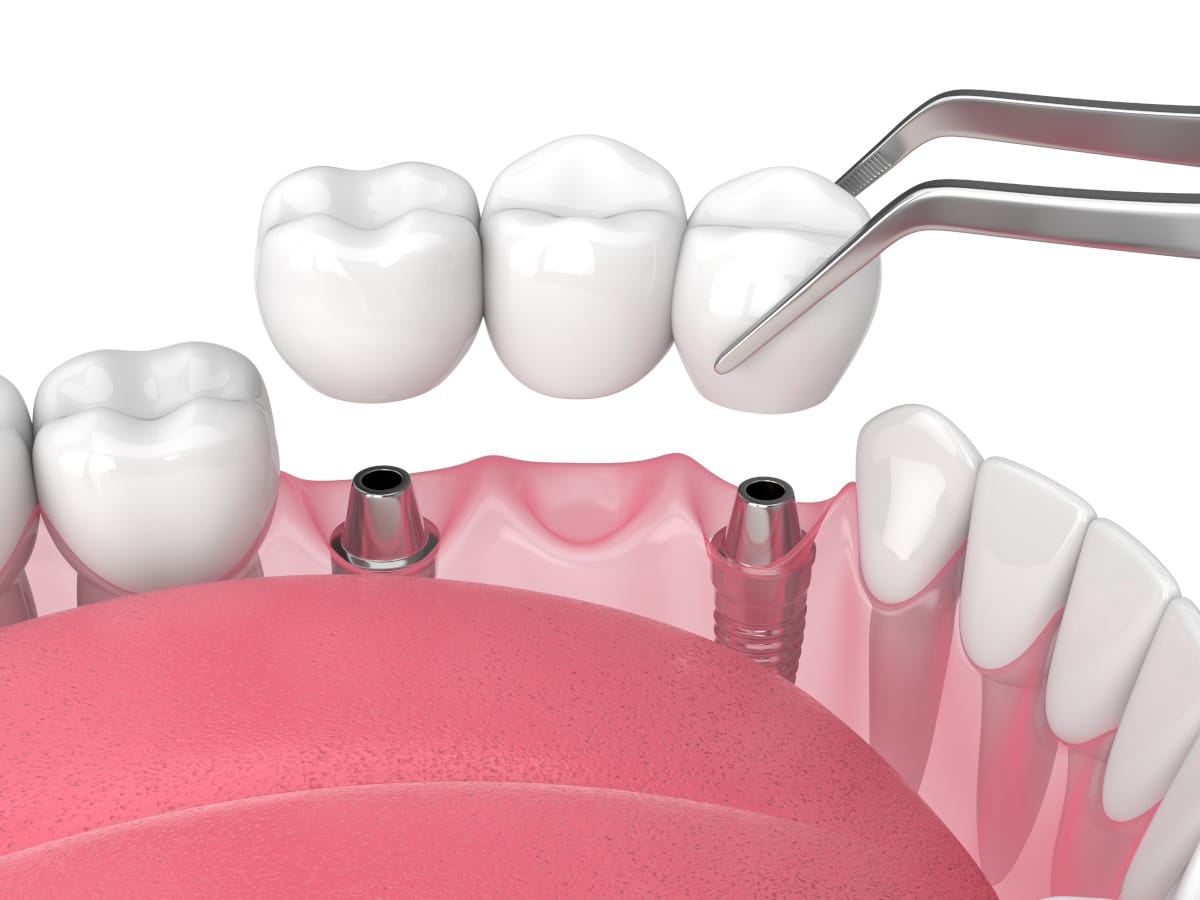
That is the structural difference, and everything else follows from it. Traditional bridges rely on adjacent teeth for support and require reshaping those teeth to accommodate the bridge. A fixed implant-supported bridge does not. A dental bridge consists of the replacement teeth plus whatever holds them; here, implants to support the span do that job.
This is how implant-supported bridges work in practice: the implants integrate with the jawbone over several months, then we attach the bridge to dental implants rather than to teeth. With the bridge in place, the implants carry everything, and no natural tooth is doing work it was not built for. The bridge provides a fixed replacement that behaves like a single unit.
You Need Fewer Implants Than You Have Missing Teeth
This is the part patients are most often surprised by, and it changes the cost picture considerably.
You do not need one implant per missing tooth. A common case is four missing lower front teeth. We place two implants, one at each end of the span, and the bridge carries two replacement teeth between them, supported at both ends. Four teeth restored, two implants placed.
The same principle scales. Three missing teeth can often be restored on two implants, using dental implants to support the whole span from each end. Longer spans may need a third to support the bridge in the middle. What determines the number of missing teeth you can restore per implant is not arithmetic but anatomy: how much bone is available, where it sits, and how much chewing force the area takes. A molar tooth carries more load than an incisor and is planned accordingly.
How Many Teeth Can An Implant Bridge Replace?
Anything from two teeth in a row up to a full arch, though the name changes as the span grows. The number of missing teeth is what decides it: two to four in a row is the classic implant-supported bridge. Beyond that, once you are replacing most or all of an arch, the structure becomes a full-arch restoration such as All-on-4, which is planned differently.
At the other end, one tooth on its own is usually better served by one implant and a crown than by any type of bridge. To replace a missing tooth in isolation there is no span to support, so there is nothing to gain.
Implant-Supported Bridge Or Individual Implants?
If you are missing three teeth, you could in principle place three implants and three separate dental crowns. Sometimes that is the right plan. Often it is not.
Separate implants make sense when there is good bone at every one of the implant sites and you want each tooth to function independently as its own unit, which makes future repairs simpler since a problem with one does not affect the others. A bridge makes sense when bone is limited at one or more sites, when the cost of additional implants is not justified by the benefit, or when the spacing is too narrow to place implants side by side without compromising how the gum sits between them.
Implant-supported bridges offer a particular advantage here. In the front of the mouth that last point carries real weight. Implants placed too close together often fail to develop healthy gum tissue between them, which leaves a visible dark triangle at the gumline. Fewer implants supporting a custom bridge frequently produces a better-looking result than more implants placed tightly.
We will tell you which applies to your case after a 3D scan, not before.
How It Compares To A Traditional Dental Bridge
A traditional bridge is anchored to dental crowns on the natural teeth either side of the gap, using those natural teeth for support. That works, and for the right patient it is a reasonable choice, but it carries three costs worth understanding.
Healthy enamel has to be removed from two existing teeth that may have had nothing wrong with them, reshaping adjacent teeth to accommodate the crowns. Those teeth then carry the chewing load of the missing teeth as well as their own, for as long as the bridge is in place. And because nothing sits in the bone where the teeth used to be, the ridge underneath continues to resorb, which is why a bridge that fit perfectly at placement can develop a visible gap underneath it years later.
An implant-supported bridge offers a way around all three. The adjacent teeth are not touched. The load goes into bone rather than onto teeth. And the implants keep the bone stimulated the way natural roots did, so the ridge holds its shape.
Unlike traditional bridges, this is also not a restoration that relies on dental cement holding onto reshaped enamel. The bridge is secured to the implants themselves.
Who Is A Good Candidate?
This tends to be the option we recommend when:
- You are missing two or more teeth in a row
- The teeth beside the gap are healthy and you would rather not crown them
- The teeth beside the gap are not sound enough to support a traditional bridge
- You have enough bone at the anchor sites, or are willing to graft to create it
- You want a fixed solution for missing teeth rather than a removable bridge or partial denture
- You are replacing one or more teeth and want to protect your long-term dental health rather than borrow from it
Bone loss does not rule you out. It changes the plan. Where the ridge has resorbed, a bone graft can rebuild the site first, and in many cases shorter or angled implants avoid grafting altogether. Active gum disease does need treating before placement — our page on dental implants with gum disease covers that sequence.
Materials
Most of the implant bridges we place now are zirconia. It is strong enough for the forces involved, it has no metal substructure that can show as a grey line at the gum, and the aesthetics have improved considerably over the past decade. Porcelain fused to metal is still used and still performs well, particularly further back in the mouth where appearance matters less than durability.
The choice is clinical rather than a menu to select from. We match the material to where the bridge sits, how much force it takes, and what your bite looks like.
What The Process Involves
- Consultation and 3D scan. A CBCT scan maps your bone volume, density, nerve position and sinus anatomy. This is what determines how many implants you need and where they go.
- Planning. The implant positions are planned digitally against your actual anatomy before anything is placed.
- Implant placement. The implants are placed under local anaesthetic, with sedation available. Most patients describe less discomfort than they expected. We can place a temporary bridge so you are not without teeth.
- Healing. The implants integrate with the bone over the following months.
- The final bridge. Once integration is confirmed, impressions go to the dental laboratory. The finished bridge is then attached to the implant abutments and the bridge is placed permanently.
Timelines vary with whether grafting is needed first and how quickly your bone integrates. We will give you a realistic schedule for your case rather than a generic one.

Before the Procedure
Before the Procedure – Missing Tooth

Step 1
Preparing the site and placing the implant

Step 2
Dental Implants Placed

Step 3
Removable Bridge vs. Implant-supported Fixed Bridge
The beautiful results
How Long Does An Implant-Supported Bridge Last?
The published figures are good, and they are worth separating into two parts, because the implants and the bridge on top of them are different components with different lifespans.
Across the pooled systematic reviews by Pjetursson and colleagues, implant-supported bridges show survival of around 95% at five years and 87% at ten years. For comparison, traditional tooth-supported bridges run at roughly 94% at five years and 89% at ten, and tooth-supported cantilever bridges drop to about 80% at ten — which is one reason we cantilever on implants rather than on natural teeth.
Two things behind those numbers matter more than the numbers themselves. Survival means the restoration is still in place; success means still in place with no complications, and the second figure is always lower. And when an implant-supported bridge does need attention, it is usually the bridge rather than the implants. The bridge can be removed, repaired or replaced without disturbing the implants underneath, which is not true of a traditional bridge cemented to prepared teeth.
These figures come from studies running from the 2000s onward, so they somewhat understate what current zirconia and digital workflows achieve.
What Are The Problems With Implant Bridges?
Worth knowing before you commit, because most pages on this subject skip it.
- Cleaning underneath takes technique. A bridge spans the gap, so there is a space between it and the gum. Floss threaders, interdental brushes or a water flosser are not optional here.
- Peri-implantitis. An implant tooth cannot decay, but the gum and bone around it can become infected. A history of periodontal disease raises that risk.
- Screw loosening and porcelain chipping. The most common technical complications. Both are fixable, and both are easier to fix on a screw-retained bridge than a cemented one.
- Treatment takes months. Longer still if grafting is needed first.
- Higher upfront cost than a traditional bridge.
Caring For Your Bridge
Proper care and maintenance is what turns a good ten-year figure into a twenty-year one. Clean underneath the bridge daily with whichever interdental tool you will actually use, brush twice a day as normal, and keep to professional cleanings — three or four a year rather than two if you have any history of gum disease. Report bleeding around the implant sites rather than waiting for your next appointment.
What Affects The Cost
An implant-supported bridge costs more upfront than a traditional bridge and less than replacing every missing tooth with its own implant. Within that range, the variables are:
- Number of implants. Two anchors cost less than three, which is why the span design matters financially as well as clinically.
- Whether grafting is needed. If the ridge has resorbed, bone may need rebuilding first.
- Material. Zirconia and porcelain-fused restorations carry different laboratory costs.
- Number of teeth on the bridge. A three-unit bridge involves less lab work than a five-unit one.
- Insurance. Coverage for implant work varies widely by plan and is worth checking before treatment.
We give you an exact cost as part of your treatment plan at your consultation, along with your insurance breakdown and financing options. Your dentist may have raised a traditional bridge as the cheaper route; it usually is upfront, and the comparison worth making is over twenty years rather than at placement.
Frequently Asked Questions
How many implants are needed to support a dental bridge? Fewer than the number of teeth you are missing. Two implants to support a bridge of three or four teeth is the common arrangement. The number depends on bone volume, position in the mouth, and chewing forces, which is what the 3D scan tells us.
Is it better than individual implants? Neither is better in general. A bridge uses fewer implants and is often the better option where bone is limited or spacing is narrow. Individual implants function independently, which simplifies future repairs. The right answer depends on your anatomy.
Does it hurt? Placement is done under local anaesthetic with sedation available. Most patients report soreness for a few days afterwards, comparable to an extraction, managed with over-the-counter pain medication.
Do implant bridges look and feel like natural teeth? Close to it, and the look and feel is what most patients comment on first. Because the load transfers into bone rather than onto teeth or gum, chewing function is much nearer natural teeth than a removable partial denture, which is the main practical difference patients notice.
Can you eat normally with an implant bridge? Once the final bridge is in place, yes.
How does an implant supported bridge protect the teeth I still have? It does not use them. Because we use dental implants to anchor the bridge rather than crowns on your own teeth, nothing is ground down and nothing extra is asked of your remaining teeth.
Will it stop bone loss? In the areas where implants are placed, yes. Tooth loss starts bone loss, and an implant stimulates the bone the way a natural tooth root did. That is the structural advantage over a traditional bridge, which sits above the gum and does nothing for the bone underneath.
Can it be removed if something goes wrong? Yes. The bridge can be taken off the implants for repair or replacement without removing the implants themselves.
Can an implant and a natural tooth support the same bridge? It is possible but generally avoided. Using implants to support a dental bridge at one end and a natural tooth at the other creates a mismatch: an implant is rigid in bone while a tooth has slight movement, and that puts uneven stress on both.
What is the difference between this and a Maryland bridge? A Maryland bridge is bonded to the back of adjacent teeth with minimal preparation and suits one missing tooth, usually a front tooth. It is a conservative, shorter-term option rather than a structural replacement.
Will dental insurance cover it? Plans vary widely. Many cover part of the restoration while excluding the implants, or the reverse. We check your specific benefits before you commit to anything.

Schedule Your Consultation
If you need to replace missing teeth in a row and want to know whether an implant-supported bridge is the right tooth replacement for your case, come in for an evaluation. Our periodontists place implant-supported dental bridges across the tristate area. We will take a 3D scan, look at your bone, and tell you honestly which approach gives you the best result.
Call (347) 493-2439 or schedule your consultation online. We see patients at our Manhattan, Nutley, NJ, Long Island and Bronxville offices.