

Gum disease is an infection of the tissues that hold your teeth in place: the gums, the ligament that attaches each tooth to its socket, and the jawbone underneath. It usually starts quietly, without pain, which is why so many adults have it without knowing. Caught early, gum disease can be reversed. Caught later, it can still be controlled, and in many cases lost support can be partly rebuilt. Left untreated, periodontal disease is a leading cause of tooth loss in adults.
Our periodontists diagnose and treat every stage of gum disease, from early gingivitis to advanced periodontitis, at our offices in Manhattan, Long Island, Westchester and Nutley, New Jersey. This page explains how gum disease progresses, how we decide on a treatment plan, and what each treatment option involves, with links to a full page on each one.
What Causes Gum Disease?
The main cause of gum disease is plaque, a sticky film of bacteria that forms on your teeth every day. When plaque isn’t removed by brushing and flossing, it hardens into tartar (calculus), which only a periodontist, dentist or dental hygienist can remove. The bacteria that cause gum disease live in that plaque and tartar, and your body’s response to them is gum inflammation. Over time, that inflammation breaks down the attachment between the gum and the tooth.
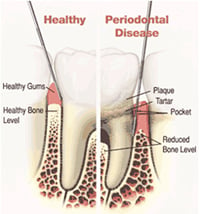
Healthy tooth (left) vs. Effects of Periodontal Disease (right)
As the gum pulls away, it leaves a gap called a periodontal pocket. Pockets trap more bacteria below the gum line, where a toothbrush can’t reach, and the disease progresses downward into the bone. That is the point where gingivitis, the mild form of gum disease, becomes periodontitis, the serious form of gum disease.
Risk Factors For Gum Disease
Some people are more prone to gum disease than others, even with similar home care. The main risk factors for periodontal disease are:
- Smoking and vaping, which reduce blood flow to the gums and hide the bleeding that would otherwise warn you. Read more about smoking and gum health.
- Diabetes, especially when blood sugar is poorly controlled. The link runs both ways, since active gum disease can make blood sugar harder to manage.
- Genetics and family history.
- Hormonal changes during pregnancy, puberty and menopause.
- Medications that cause dry mouth or gum overgrowth.
- Clenching or grinding, chronic stress, and conditions that weaken the immune system.
Signs And Symptoms Of Gum Disease
The early signs of gum disease are easy to dismiss. Bleeding gums when you brush or floss is the most common one, and healthy gums don’t bleed. Other symptoms of gum disease include:
- Red, swollen or tender gums.
- Persistent bad breath or a bad taste.
- Gums that are pulling back, making teeth look longer. See our page on receding gums.
- Pus between the teeth and gums.
- Teeth that feel loose, shift, or have new gaps between them.
- A change in how your bite fits together.
Many people with periodontitis have none of these. That is why a periodontal evaluation matters even if nothing hurts.
The Stages Of Gum Disease
Your treatment plan depends on how far the disease has progressed. Our periodontists measure the depth of the space between each tooth and its gum with a small probe. Healthy pockets measure around 1 to 3 millimeters.
- Gingivitis. The earliest stage of gum disease. The gums are inflamed and may bleed, but no bone has been lost. Gingivitis is reversible with professional cleaning and better home care.
- Mild periodontitis. Pockets start to deepen and early bone loss shows on X-rays.
- Moderate periodontitis. Deeper pockets, more bone loss, and sometimes gum recession or slight looseness.
- Advanced periodontitis. Pockets deeper than 6 to 7 millimeters, significant bone loss, and teeth that may be loose or drifting. This is advanced gum disease, and the goal of treatment is to save every tooth that can be saved.
How We Diagnose Periodontal Disease
Diagnosis and treatment go together. At your consultation, we chart pocket depths around every tooth, note where the gums bleed, check for recession and looseness, and take X-rays to see the bone. When we need a three-dimensional view of the bone around a tooth or a planned implant site, we use CBCT 3D imaging. We also ask about your health history, because diabetes, smoking and medications all change how gum disease behaves and how it responds to treatment.
Gum Disease Treatment Options
There is no single best way to treat gum disease. The right type of treatment depends on the stage, the depth of the pockets, how much bone has been lost, and your overall health. Here are the treatment options we offer, from least to most involved.
Professional Cleaning For Gingivitis
For gingivitis, a thorough professional cleaning to remove plaque and tartar, combined with better brushing and flossing at home, is usually enough. The gums typically settle within a few weeks.
Scaling And Root Planing (Deep Cleaning)
Scaling and root planing is the standard non-surgical treatment of periodontal disease. Scaling removes plaque and tartar from the tooth surfaces and from inside the pockets, below the gum line. Root planing then smooths the root surfaces so the gum tissue can reattach and the pockets can shrink. It is done under local anesthesia, usually one section of the mouth at a time. For many patients with mild to moderate periodontitis, scaling and root planing alone brings the disease under control. Read the full guide to scaling and root planing.
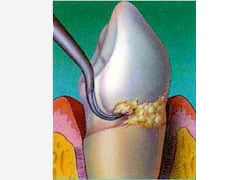
Plaque and tartar (yellow or brown Hardened plaque) are scraped off the tooth’s crown and roots.
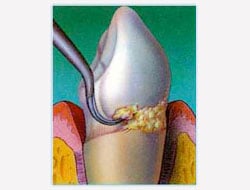
After Scaling, the rough surfaces of the root are smoothed, providing a healthy surface for healing.
LANAP Laser Gum Surgery
When pockets are deeper than about 5 to 6 millimeters, deep cleaning on its own often can’t reach the bottom of them. For these cases, LANAP (Laser-Assisted New Attachment Procedure) is often a better option than traditional gum surgery. A laser removes the infected lining of the pocket and kills the bacteria, without cutting and stitching the gum. Patients generally have less discomfort and swelling, and the procedure is designed to let the gum reattach and bone regenerate around the tooth. All of our periodontists are trained in LANAP. Learn more about LANAP laser gum surgery.
Flap Surgery (Pocket Reduction)
In some advanced cases, we need direct access to the roots. During flap surgery, the gum is gently lifted back so we can clean the roots and remove diseased tissue that scaling can’t reach. Uneven bone may be reshaped so the area is easier to keep clean, and the gum is then repositioned and stitched in place. The result is shallower pockets that you and your hygienist can maintain.
Regeneration And Bone Grafting
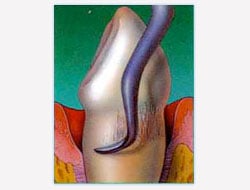
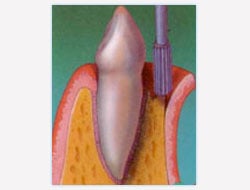
The gum is lifted from the tooth and bone, and diseased tissue is removed. The uneven bone may also may be reshaped.
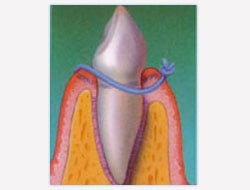
After surgery, the gum is repositioned and sutured in place.
Where gum disease has destroyed bone around a tooth, regeneration can sometimes rebuild part of it. Guided tissue regeneration uses a membrane, often with a bone graft, to give bone and attachment room to regrow instead of being filled by gum tissue. Not every defect is a candidate, and we’ll tell you honestly whether yours is. Read more about bone regeneration.
In some cases, destroyed tissue between teeth or roots can be partially regenerated.
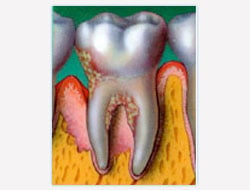
Once the damaged area is prepared and special membranes are inserted, new tissue can grow over a period of weeks and months.
Treating Gum Recession
Gum recession often develops alongside gum disease, exposing the roots and making teeth sensitive. Once the disease is under control, recession can be treated with gum grafting or the Pinhole Surgical Technique, which repositions the gum through a small entry point instead of a graft.
Do Antibiotics Cure Gum Disease?
No. Antibiotics can support treatment in some cases, but they can’t remove tartar or clean out a pocket, so on their own they don’t cure periodontitis. The infection is controlled by physically removing the bacteria and their deposits, which is what the professional treatments above do.
Can Gum Disease Be Cured?
Gingivitis can be fully reversed. Periodontitis can be stopped and kept stable, and with LANAP or regenerative procedures some lost support can be regained, but it is a chronic condition. That means it needs ongoing care to prevent gum disease from coming back. After active treatment, most patients move from twice-yearly cleanings to periodontal maintenance visits every few months, and we set the interval based on how your gums respond.
What Happens If Gum Disease Is Left Untreated?
Untreated periodontitis keeps destroying bone and attachment until teeth loosen and are lost. It also makes later treatment harder: bone lost to gum disease often has to be rebuilt before a dental implant can be placed. Gum disease has also been associated with cardiovascular disease, diabetes and other health problems, and treating it is part of looking after your overall health, not just your oral health.
Gum Disease And Dental Implants
If you’ve already lost teeth to gum disease, dental implants are a reliable way to replace them, but the gum disease has to be treated first. Implants can also develop their own version of the disease, called peri-implantitis, so periodontal care continues after an implant is placed. Can you get dental implants with gum disease? explains how we plan these cases, and our page on peri-implantitis treatment covers infections around implants.
How To Prevent Gum Disease At Home
Good oral hygiene is the foundation of every treatment plan, and it is the best way to keep gum disease from returning:
- Brush twice a day for two minutes, angling the bristles toward the gum line.
- Clean between your teeth every day with floss, interdental brushes or a water flosser.
- Don’t smoke or vape.
- If you have diabetes, keep your blood sugar under control.
- Keep every maintenance visit, even when your gums feel fine.
Mouthwash and special toothpastes can help, but no rinse or home remedy can treat gum disease once tartar has formed below the gum line. That takes professional treatment.
Other Gum Treatments We Offer
Beyond treating gum disease, our periodontists also treat cosmetic and structural gum problems, including gummy smile correction, gingivectomy, crown lengthening and gum depigmentation.
Gum Disease Treatment In NYC, Long Island And New Jersey
We treat gum disease at four offices: Manhattan (110 E 40th St.), Franklin Square on Long Island, Bronxville in Westchester, and Nutley, New Jersey. Treatment plans are tailored to your stage of gum disease, your health history and your goals, and we’ll explain your options and your insurance coverage before anything begins. Find the office nearest you.
If your gums bleed, look swollen or are receding, or it has simply been a while since your last periodontal evaluation, don’t wait for it to hurt. Call us at (347) 493-2439 or Book A Consultation online.
Frequently Asked Questions
Does Gum Disease Treatment Hurt?
Most gum disease treatment is done under local anesthesia, so you shouldn’t feel pain during it. Some tenderness afterward is normal. LANAP patients generally report less discomfort and swelling than with traditional gum surgery.
How Long Does Gum Disease Treatment Take?
Scaling and root planing is usually done over one or two visits. We then re-check your pocket depths several weeks later to see how the gums have responded and decide whether any further treatment is needed.
Is Gum Disease Treatment Covered By Insurance?
Many dental plans cover part of periodontal treatment, especially scaling and root planing. Coverage varies by plan, so we check your benefits with you before treatment. See our accepted dental insurance plans.
Can Gum Disease Go Away On Its Own?
Gingivitis can improve with better brushing and flossing. Periodontitis can’t, because tartar and bacteria deep in the pockets can only be removed with professional treatment.
Is Periodontitis Serious?
Yes. It is a leading cause of tooth loss in adults and has been associated with cardiovascular disease and diabetes. With treatment and regular maintenance, though, most people keep their teeth and live a normal life with well-controlled gum disease.
How Common Is Gum Disease?
Very. About 42 percent of adults in the United States aged 30 and older have some form of periodontitis, according to CDC data reported by the National Institute of Dental and Craniofacial Research. Rates rise with age.
Should I See A Dentist Or A Periodontist For Gum Disease?
Your general dentist can treat gingivitis and often mild periodontitis. A periodontist is a specialist with additional years of training in gum disease, gum surgery and dental implants, and is the right choice for deeper pockets, bone loss, recession, or gum disease that keeps coming back.