Smile in a Day™ replaces a failing or missing set of teeth with dental implants and a fixed bridge in a single surgical visit. You arrive with the teeth you have and leave the same day with a full set of fixed teeth held on implants. It is the same treatment people search for as teeth in a day, same-day dental implants, or a new smile in one day.
What follows is how the procedure works, who it suits, who it does not, and what happens in the months after the day itself.
What Is Smile In A Day™?
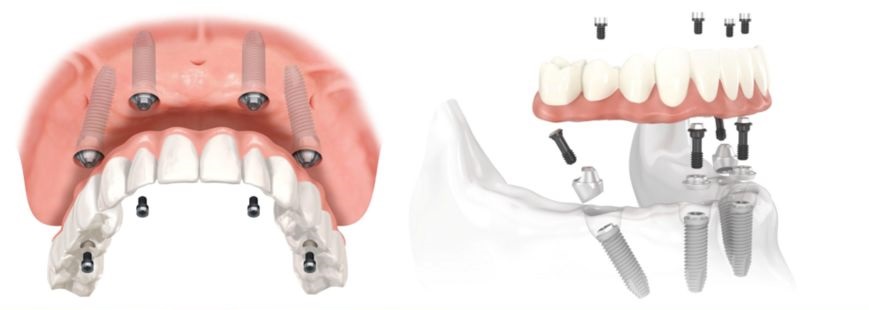
Smile in a Day™ is full mouth dental implants delivered in one appointment. Four to six titanium implants are placed into the jawbone, and a fixed bridge is attached to them the same day.
The difference from traditional dental implant treatment is not the implants themselves. It is the waiting. Conventional implants are placed, left to heal for months, and restored afterwards, so patients spend that period in a removable denture or without teeth. Smile in a Day™ gives you fixed teeth on the day the implants go in.
The finished result is an implant supported bridge: prosthetic teeth carried entirely by the implants in your jaw, not resting on your gums.
Do You Go Without Teeth While The Implants Heal?
No. That is the entire point of the treatment.
A fixed bridge is secured to the implants before you leave the dental office. It does not come out, it is not a removable denture, and there is no gap period. You eat, speak and go to work with a full set of teeth in place while the implants are healing underneath.
This is the question patients ask most and the one most dental clinics answer least clearly. Going months without teeth, or wearing a loose temporary denture over healing implants, is what makes people avoid implant treatment altogether.
How Does Smile In A Day™ Work?
- Assessment and planning. A 3D CBCT scan and a digital scan of your teeth and gums show the available bone, the nerve positions and the sinus floor. Implant placement is planned in software before the day.
- Extractions. Any remaining teeth that cannot be saved are removed at the start of the appointment.
- Implant placement. Typically four to six implants are placed per arch, angled to use the strongest available bone.
- Fitting the bridge. A fixed provisional bridge is made to fit the dental implant posts and secured the same day.
- The final restoration. Once the implants fuse to the jawbone, the provisional is replaced with your permanent teeth.
The surgical visit takes a single day. Osseointegration, where bone grows onto the implant surface and locks it in place, carries on for months afterwards whether or not there are teeth attached.
Is The Same-Day Bridge Your Permanent Set Of Teeth?
No, and this is worth being straight about, because a lot of advertising blurs it.
What goes on during the day is a long-term provisional. It is fixed, it looks and feels like teeth and it functions as teeth, but it is a working prototype rather than the finished restoration. It is deliberately lighter than the final bridge so that the healing implants are not overloaded.
It also does a job nothing else can. You live with it, and what you learn about the shape, the length and the bite gets built into the permanent set of teeth that replaces it. Patients told that their day-one temporary teeth are the final restoration are usually being sold something rather than told something.
How Do We Know The Implants Can Take Teeth On The Day?
We measure it rather than assume it.
An implant placed into good bone has mechanical grip from the moment it goes in, and that grip is what carries the provisional bridge before any biological fusion has happened. Its strength varies by patient and by site. Implant stability can be measured objectively using resonance frequency analysis, which gives a reading on the implant stability quotient, or ISQ, scale. We use an Osstell unit for this.
Where the readings support it, the bridge goes on that day. Where they do not, the honest answer is to wait, and a patient is better served by hearing that than by having an implant loaded that cannot take it. Splinting the implants placed across the arch under one bridge also spreads the load so no single implant carries the force alone.
Who Is Not A Good Candidate For Smile In A Day™?
Most people with a failing or missing arch are a candidate for Smile in a Day™. Some are not, and the consultation exists to establish which.
- Not enough bone to hold implants firmly on the day. The implants can still be placed, but the teeth may need to wait.
- Active infection in the jaw at the planned implant sites.
- Uncontrolled diabetes or another condition that materially affects healing.
- Heavy smoking. It raises failure rates and is worth an honest conversation before implant surgery, not after.
- Severe bruxism without a plan to manage it, because grinding forces are hard on a healing arch.
Being told elsewhere that you have too little bone for dental implants is not the same as being unsuitable. Angled placement, zygomatic and pterygoid implants exist precisely for jaws that conventional implants cannot handle, and a second opinion is worth having before you accept dentures.
Will I Need A Bone Graft?
Often not. Angling implants to reach the denser bone at the front of the jaw is one reason this dental procedure avoids grafting where conventional implant placement would need it.
Where bone loss is severe, grafting may still be part of the plan, or the case may call for implants anchored into bone beyond the jaw itself. That is determined from the CBCT scan, not from an examination alone.
How Long Does Smile In A Day™ Last?
The implants are intended to be permanent. Published survival rates for full arch implant treatment are high over ten years and beyond, and we still see patients whose implants were placed decades ago.
The bridge on top is a different matter. It is a prosthetic, it wears, and it can be repaired or replaced without disturbing the implants underneath. Regular maintenance with a periodontist and good dental care at home make more difference to how long the whole thing lasts than any other single factor, because the dental health of the gums and bone around implants is what holds them.
What Does Smile In A Day™ Cost?
It depends on the arch, and an accurate figure needs an examination and a CBCT scan.
What moves the price is how many implants are needed, whether extractions or bone grafting are involved, the material chosen for the final bridge, and whether one arch or both are treated. Full mouth dental implants are priced per arch rather than per implant, and financing is available.
It is worth comparing quotes on what is included. Some cover the implants and the provisional only, with the final bridge priced separately later.
Smile In A Day™ Compared To Traditional Implants
Both use the same implants and the same biology. The sequence is what differs.
- Traditional implants: implants placed, several months of healing with no fixed teeth, then the restoration. Often more visits, and usually a removable denture in between.
- Smile in a Day™: extractions, implant placement and a fixed bridge in one appointment, with the permanent teeth fitted after the implants have integrated.
Neither is better in the abstract. A single missing tooth does not need this treatment, and a mouth with healthy existing teeth worth keeping may be better served by conventional implant treatment around them.
How Is It Different From Teeth In An Hour™ And All-on-4™?
They overlap, and the names cause more confusion than they need to.
All-on-4™ describes the configuration: a full arch of fixed teeth carried on four implants. Teeth in an Hour™ is a guided protocol where the placement itself is completed very quickly. Smile in a Day™ describes what the patient experiences, which is walking out with fixed teeth on the day of surgery.
In practice the right answer is decided by your anatomy rather than by the name of the protocol.
Speak To A Periodontist
If you are weighing up full arch dental implants, or you have been told you are not a candidate, an assessment is the place to start. Our periodontists have been placing implants for over twenty years across Manhattan, Nutley, Long Island and Westchester, and a large share of what we see is work that began somewhere else.
Call (347) 493-2439 or book a consultation. A 3D CBCT scan is included at your consultation at no charge, and implants that look and feel like natural teeth are the outcome we are working towards.

Dr. Richard Nejat, DDS
Dr. Richard Nejat is a board-certified periodontist offering leading-edge dental implant placement and gum surgery techniques. Dr. Nejat has completed many years of advanced training at highly recognized medical institutions and is a member of numerous leading professional organizations. Recognized as a foremost New York dental implants provider, Dr. Richard Nejat is frequently invited to lecture at professional seminars and symposiums. Dr. Nejat has been practicing since 1997.
Dr. Nejat is a member of the American Board of Periodontology, American Academy of Periodontology, Academy of Osseointegration, Northeastern Society of Periodontists, New Jersey Society of Periodontists, New York Dental Society, and International Congress of Oral Implantologists.