
An implant-supported crown is the most complete way to replace a single missing tooth. A small titanium post is placed into the jawbone where the root used to be, a connector called an abutment sits on top of it, and a custom-made crown is attached to that. Once it is finished, the crown looks like a natural tooth, you brush and floss it like one, and nothing is borrowed from the teeth on either side.
This page explains how a single implant crown is built, how it differs from a regular dental crown and from a bridge, what the treatment involves, how long it lasts, and what drives the cost. If you would rather talk it through, call us at (347) 493-2439.

What Is An Implant-Supported Crown?
A single dental implant supported crown has three parts, and only one of them is visible:
- The implant. A screw-like titanium post that is placed into the jawbone and fuses with it, taking over the job of the tooth root.
- The abutment. The connector that joins the implant to the crown and shapes how the gum sits around the new tooth.
- The crown. The custom crown you see and chew with, shaped and shaded so it matches the color of your surrounding teeth.
Because the implant replaces the root as well as the tooth, the restoration is anchored in bone rather than resting on the gum or leaning on neighboring teeth. That is what makes it the standard treatment for a single missing tooth when the bone and gums allow it.
Implant Crown Vs. A Traditional Dental Crown
A traditional dental crown is a cap cemented over a natural tooth that still has its own root. An implant crown sits on a titanium root instead. The two can look identical in the mouth, but they fail in different ways. A natural tooth under a crown can still decay or need a root canal. An implant cannot decay, although the gum and bone around it still need looking after, which is why periodontists pay close attention to gum health before and after treatment.
Implant-Supported Crown Vs. Abutment-Supported Crown
You may see both terms on a treatment plan or an insurance form. In everyday use they describe the same treatment. The technical difference is how the crown is fixed:
- Screw-retained. The crown and abutment are made as one piece and screwed directly into the implant. It can be removed by your periodontist if it ever needs repair, and there is no dental cement below the gum.
- Cement-retained. The abutment is screwed into the implant first, and the crown is cemented onto it, much like a regular crown.
Insurance billing uses different codes for the two, which is where most of the confusion comes from. Clinically, the choice depends on where the tooth is, the angle of the implant, and how much space there is. Where cement is used, any excess left under the gum can cause gum irritation and, over time, peri-implantitis, so it has to be cleaned away completely.
Why Choose A Single Implant Crown Over A Bridge Or Partial Denture?
There are three common ways to replace one tooth, and each has its place:
- Traditional bridges use the adjacent teeth for support, which means shaping two healthy teeth to carry the replacement between them.
- A removable partial denture is the lowest-cost option but rests on the gum and does not stop bone loss underneath.
- An implant-supported crown stands on its own, leaves the neighboring teeth untouched, and helps prevent bone loss by keeping the jawbone in use.
That last point matters more than most people expect. After a tooth is lost, the bone in that spot shrinks because nothing is stimulating it, and the teeth next to the gap can drift. An implant into the jawbone keeps jawbone density and jawbone health where they should be, which also protects your facial structure over the long term. If several teeth are missing in a row, an implant-supported bridge may be the better solution for replacing multiple teeth.
The Implant Crown Treatment Process
Replacing a single missing tooth with an implant crown usually happens in stages over a few months:
- Consultation and 3D planning. We examine the gums, take a full set of x-rays or CBCT scan to measure the bone, and plan the implant position digitally. If bone is thin, a graft may come first.
- Implant surgery. The implant is placed under local anesthesia, with sedation available. Most patients describe it as easier than the extraction that came before it.
- Healing period. Over roughly three months the implant integrates with the bone, a process called osseointegration. In the front of the mouth, a temporary tooth can often be worn during this time.
- Digital impression and fabrication. Once the implant is stable, we take a digital scan and the custom-designed crown is made to fit your bite and match your natural teeth.
- Placing the crown. The crown is screwed or cemented onto the implant, the bite is checked, and the restoration is complete.

Before the procedure
Before the Procedure – Missing Tooth

Step 1
Preparing the site and placing the implant

Step 2
Ceramic Zirconium Abutment in place

Step 3
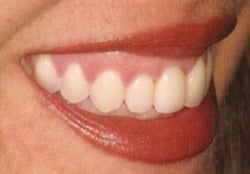
The Beautiful Results
Step 4
Preparing the site and placing the implant
Types Of Implant Crown Materials
Dental implant crowns are made from a few main materials:
- Zirconia. Very strong and tooth-colored, often chosen for back teeth where durability matters most.
- All-ceramic material such as lithium disilicate, favored in the front of the mouth for the most natural-looking aesthetic result.
- Porcelain fused to a metal base. A long-established option that combines strength with a tooth-colored surface.
Composite material is sometimes used for a temporary crown but not for the final restoration. Your periodontist will recommend a material based on where the tooth is, how hard you bite, and how visible it is when you smile.
How Long Does A Dental Implant Crown Last?
The implant itself is designed to be long-lasting and, with good care, can last for decades. The crown on top takes the daily wear of chewing and may eventually need replacing, often after many years of service. The biggest factors in the durability of the whole restoration are gum health, not smoking, keeping up with cleanings, and managing grinding with a night guard if you clench.
How Much Does An Implant-Supported Crown Cost?
The cost of a single implant crown depends on whether a bone graft is needed, the crown material, whether the abutment is stock or custom, and how many visits the case takes. We give you a written treatment plan with the full cost before anything begins. Dental insurance often covers part of the crown and sometimes part of the implant, and financing is available for the remainder.
Caring For Your Implant Crown
Brush twice a day, clean between the implant and the adjacent teeth every day with floss, a water flosser, or small brushes, and keep regular cleaning visits. Implants do not decay, but the gum around them can become inflamed in the same way it can around natural teeth, and catching it early is what protects the bone.

Book A Consultation
If you are missing one tooth, or have a tooth that cannot be saved, our periodontists can tell you whether an implant-supported crown is right for you and what it would involve. Call (347) 493-2439 or book a consultation. We see patients at our Manhattan, Nutley, NJ, Long Island and Bronxville offices.
Frequently Asked Questions
Is An Implant Crown The Same As A Dental Implant?
Not quite. The dental implant is the titanium post in the bone. The implant crown is the visible tooth attached to it. Together, with the abutment, they make up the implant-supported crown.
Is An Implant-Supported Crown Better Than A Traditional Crown?
They solve different problems. A traditional crown restores a damaged tooth that still has its root. An implant-supported crown replaces a tooth that is already missing or cannot be saved.
How Long Does It Take To Get An Implant Crown From Start To Finish?
Usually four to five months for a straightforward case, most of which is healing time. If the tooth has to be removed and the site grafted first, allow seven to eight months.
Does Getting An Implant Crown Hurt?
The surgery is done under local anesthesia, so you should not feel pain during it. Most patients manage the following few days with over-the-counter pain relief.
Who Is A Good Candidate?
Most healthy adults with one missing tooth and enough bone, or bone that can be grafted, are candidates. Uncontrolled diabetes and untreated gum disease need to be addressed first. Smoking doesn’t rule you out: we plan around it case by case.